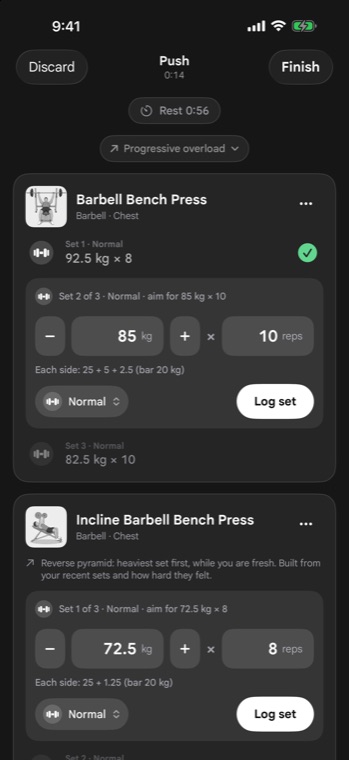
For decades, resistance training programming has been dominated by rigid, percentage-based spreadsheets. Lifters walk into the gym with predetermined weights and rep counts calculated from a one-rep maximum (1RM) tested weeks or months prior. However, human biological systems are not static machines. Daily sleep quality, psychological stress, nutritional glycogen availability, and autonomic nervous system readiness fluctuate continuously. Forcing a prescribed 90% load on a day when your neuromuscular system is operating at 80% capacity leads to catastrophic technical breakdown, blunted adaptation, and increased injury risk. Conversely, capping your performance on a day when you are feeling exceptional leaves massive strength adaptations untapped. This is where intuitive training and biological autoregulation revolutionize modern strength science.
In this comprehensive guide, we unpack the physiology of intuitive training, trace the evolution from Borg’s perceived exertion to modern Reps in Reserve (RIR) and sensor-based velocity tracking, and provide a concrete framework for integrating autoregulated training into your workouts using an intelligent workout tracker and companion smartwatch sensors.
1. The Biology of Neuromuscular Readiness: Why Fixed Percentages Fail
In classical linear periodization models pioneered in the mid-twentieth century, training loads were dictated as fixed percentages of a lifter’s historic 1RM. For example, a program might prescribe four sets of six repetitions at 80% of 1RM on the barbell back squat. While this model provides mathematical elegance on paper, it suffers from a fatal biological flaw: your true maximal strength fluctuates by 10% to 15% on any given day.
Multiple physiological mechanisms explain this acute performance volatility:
- Autonomic Nervous System Tone: The balance between sympathetic (fight or flight) and parasympathetic (rest and digest) branches directly dictates motor unit recruitment speed. Elevated life stress, financial anxiety, or poor nocturnal recovery depresses parasympathetic reactivation, blunting high-threshold motor unit firing rates.
- Glycogen Substrate Availability: Skeletal muscle glycogen stores fluctuate based on carbohydrate intake and metabolic demands over the preceding 24 to 48 hours. Sub-optimal glycogen depletion impairs calcium release from the sarcoplasmic reticulum during excitation-contraction coupling, causing premature muscular fatigue.
- Central vs. Peripheral Fatigue Accumulation: Heavy compound lifting generates both peripheral fatigue (within the muscle fibers themselves) and central nervous system (CNS) fatigue (a reduction in voluntary neural drive from the motor cortex). While peripheral fatigue dissipates relatively rapidly, central fatigue can linger for 48 to 72 hours, secretly depressing maximal force production.
- Circadian and Hormonal Oscillations: Core body temperature, joint synovial fluid viscosity, and testosterone-to-cortisol ratios vary significantly depending on time of day and sleep architecture.
When an athlete attempts to force a fixed percentage load on a physiologically compromised day, the relative intensity skyrockets. What was intended as a moderate 2 RIR working set transforms into a grinding 0 RIR or technical failure set. This dramatically accelerates systemic fatigue accumulation, sabotages subsequent training sessions in the microcycle, and places connective tissues under extreme injury risk.
2. The Evolutionary Ladder of Autoregulation: From Borg to RPE and RIR
To solve the limitations of fixed percentages, exercise scientists developed autoregulation: the systematic adjustment of training variables based on real-time biological feedback during the workout itself.
Level 1: Borg’s Original RPE Scale (6 to 20)
In 1970, Swedish psychologist Gunnar Borg created the Rating of Perceived Exertion (RPE) scale, ranging from 6 to 20 to correlate roughly with heart rate during aerobic cycling and running (e.g., an RPE of 12 corresponded to approximately 120 bpm). While groundbreaking for cardiovascular exercise, Borg’s scale proved difficult to apply to low-repetition, high-intensity resistance training where cardiovascular strain does not correlate with muscular failure.
Level 2: The Mike Tuchscherer RPE System (1 to 10)
In the mid-2000s, powerlifter and coach Mike Tuchscherer adapted RPE specifically for strength training by introducing a 1 to 10 scale anchored to concentric muscular failure. An RPE of 10 represented absolute maximal effort where no additional repetitions could be completed. An RPE of 9 indicated that exactly one more repetition was possible, while an RPE of 8 indicated two repetitions remained.
Level 3: Reps in Reserve (RIR)
Recognizing that “perceived exertion” was often confounded by subjective sensations of muscular burning or cardiovascular breathing rate, researchers Dr. Eric Helms and Dr. Michael Zourdos codified the Reps in Reserve (RIR) framework. RIR directly asks the trainee: “How many more clean repetitions could you have completed before technical failure?” An RPE of 8 translates directly to 2 RIR. This shift provided lifters with an objective, concrete metric to guide set termination.
Level 4: Sensor-Based Objective Velocity Tracking (IMU Telemetry)
While RIR represents a massive leap forward, it remains partially vulnerable to psychological bias. Inexperienced lifters frequently underestimate their true capacity by 2 to 4 repetitions, while over-motivated lifters overestimate their capacity and grind into involuntary failure. The ultimate frontier of autoregulation is sensor-based intuitive training. By leveraging the tri-axial accelerometer and gyroscope hardware inside an Apple Watch or Wear OS smartwatch, modern algorithms track the physical speed of the barbell or dumbbell in real time, converting subjective feelings into objective kinetic data.
3. The Biomechanics of Bar Velocity and Neuromuscular Fatigue
In human kinesiology, the force-velocity relationship is an immutable physical law: as external resistance increases, concentric movement velocity unavoidably decreases. Furthermore, during a multi-rep working set, every successive repetition experiences a subtle decrease in mean concentric velocity (measured in meters per second, m/s) due to accumulated intra-set fatigue.
Extensive sports science research (pioneered by González-Badillo and colleagues) confirms that the velocity of your final repetition prior to concentric failure (known as the Minimum Velocity Threshold, or MVT) is extraordinarily stable for a given exercise. For example, across elite and intermediate lifters, the MVT for the barbell bench press is consistently between 0.12 m/s and 0.18 m/s. Regardless of whether you are lifting 80 kg or 140 kg, when your bar speed drops to 0.15 m/s, you have reached 0 RIR.
By monitoring the rate of velocity loss across a set via high-frequency wearable sensors, intelligent software can accurately predict your exact RIR before you reach dangerous failure. If your opening repetition on a squat moves at 0.65 m/s, your nervous system is firing with exceptional readiness. If that same load on a different day moves at only 0.48 m/s, your system is carrying unrecovered central fatigue. An intuitive tracker alerts you to dial back the load by 5% to 7.5%, ensuring you achieve the precise hypertrophic stimulus without drowning in unnecessary systemic fatigue.
4. Comprehensive Autoregulation Comparison Matrix
The following table outlines how different training modalities compare across objective accuracy, cognitive demand, and practical gym execution:
| Training Philosophy | Primary Driving Variable | Day-to-Day Readiness Adaptation | Risk of Overtraining | Equipment & Tools Required |
|---|---|---|---|---|
| Fixed Linear Percentages | Static % of historic 1RM (e.g., 5×5 at 80%) | Zero; completely ignores biological fluctuations | High on bad days; low stimulus on great days | Paper notebook or standard spreadsheet |
| Subjective RPE / RIR | Estimated reps remaining before failure (0-3 RIR) | High; weights adjusted to match daily target RIR | Moderate; depends heavily on lifter honesty | Standard digital workout tracker |
| Sensor-Based Intuitive Lifting | Live kinematic velocity & IMU deceleration curves | Continuous real-time biological autoregulation | Extremely low; warns against premature failure | Companion smartwatch (Apple Watch or Wear OS) |
| Pure Unstructured Instinct | Vague emotional feelings and gym atmosphere | Uncontrolled; lacks progressive overload discipline | Very high; prone to chronic under- or over-training | None; completely unstructured |
5. Step-by-Step Protocol: Implementing Intuitive Training in Your Mesocycle
To successfully transition from rigid spreadsheets to intuitive autoregulation without sacrificing progressive overload, follow this four-phase protocol:
Phase 1: Establishing Repetition Velocity and RIR Anchors
During the first two weeks of your training block, anchor your primary compound movements to target RIR brackets rather than static weights. For example, program your Barbell Romanian Deadlift for 3 sets of 8 repetitions at 2 RIR. Your goal is not to hit a predetermined number, but to choose a weight that naturally terminates each set with exactly two clean repetitions left in the tank.
Phase 2: Calibrating Warm-up Velocity as a Readiness Gauge
Use your warm-up sets as a biological barometer. When warming up to your working weight on the bench press, observe how the last warm-up single (e.g., 80% of working weight) moves on your smartwatch sensor. If the bar moves rapidly with crisp acceleration, your neuromuscular system is primed; you can aggressively push your working load toward the top of your target bracket. If the warm-up feels sluggish and bar velocity is depressed by more than 10%, autoregulate downward and select a conservative working weight.
Phase 3: Real-Time Intra-Set Velocity Governance
During working sets, maintain maximal concentric intent on every single repetition. Do not intentionally move the bar slowly on the way up; drive as hard as possible through the concentric phase while maintaining strict technical positioning. As fatigue accumulates, your sensor-enabled intuitive training app tracks the velocity decay. When velocity drops by 20% to 30%, terminate the set. Research confirms that stopping sets before reaching excessive velocity loss stimulates identical muscle hypertrophy while producing 50% less systemic neuromuscular fatigue.
Phase 4: Linking Performance with Sleep and Systemic Readiness
Autoregulation inside the gym must be matched with recovery tracking outside the gym. If your sleep tracker indicates truncated deep slow-wave sleep or a depressed heart rate variability (HRV) baseline, expect your intuitive training threshold to drop. Conversely, on days following nine hours of deep sleep and complete glycogen repletion, capitalize on the biological window by pursuing progressive overload personal records.
6. Common Misconceptions About Intuitive Training
Misconception 1: “Intuitive Training Means Doing Whatever You Feel Like”
Intuitive training is not an excuse for lazy, unstructured workouts. It is a precise scientific framework where the target stimulus (e.g., 2 RIR at a specific velocity) is strictly enforced, while the external load is allowed to fluctuate to match your true physiological capacity. The exercise selection, rep brackets, and technical execution remain completely structured.
Misconception 2: “You Can Only Build Muscle by Going to Absolute Failure”
Dozens of peer-reviewed studies over the past decade have debunked the myth that sets must be taken to agonizing concentric failure to trigger hypertrophy. Training to absolute failure (0 RIR) creates disproportionate neurological fatigue and muscle damage without offering superior myofibrillar protein synthesis compared to stopping 1 to 2 reps short of failure. Intuitive training prevents the accumulation of unnecessary junk fatigue.
Misconception 3: “Beginners Can Rely Purely on Intuition”
True subjective intuition requires an internal library of physical experience. Novice lifters often believe they are at 0 RIR when they actually have 5 or 6 repetitions remaining because they are unfamiliar with the sensation of deep muscular burn. For beginners, pairing subjective RIR ratings with objective smartwatch sensor feedback provides the cognitive feedback loop needed to calibrate true effort accurately.
7. Advanced Troubleshooting: Managing Psychological and Environmental Biases
Even experienced athletes can fall victim to psychological bias when autoregulating. On days when you are mentally stressed or emotionally drained from work, your brain will scream that you are fatigued even when your muscles are physiologically fresh. This is known as “perceived central fatigue.”
To overcome this bias, rely on the “One Set Rule.” Warm up thoroughly, step under the bar, and execute your first working set with maximal explosive intent. Glance at your wearable velocity readout: if your bar speed is high despite your low mood, your fatigue was purely psychological; proceed with your normal training weights. If your velocity is objectively depressed, your fatigue is biological; autoregulate the load downward with confidence.
8. Frequently Asked Questions
How does intuitive training integrate with progressive overload?
Intuitive training enhances progressive overload by ensuring that every increase in load or volume reflects genuine biological adaptation rather than forced, destructive overreaching. Over a 6-week block, your average load at a standardized 2 RIR will steadily climb as your baseline strength expands.
Can I use intuitive training on single-joint isolation exercises?
Yes, though the metrics adjust slightly. On isolation exercises like dumbbell lateral raises or bicep curls, velocity tracking is less critical than strict technical RIR governance. Because isolation movements pose minimal systemic fatigue or spinal loading, taking sets closer to failure (0 to 1 RIR) is safe and effective.
Does intuitive training work for powerlifters peaking for a meet?
Powerlifting coaches worldwide (including RTS and Reactive Training Systems) rely heavily on RPE and velocity autoregulation during peaking cycles. It ensures that lifters peak their maximal neural drive without accumulating excessive fatigue that blunts competition day expression.
What role does nutrition play in daily lifting intuition?
Intra-workout stamina is fueled by glycogen and hydration. If you fail to hit your carbohydrate targets on an integrated macro tracker, your intra-set endurance and bar speed will degrade rapidly, forcing your intuitive training system to dial back volume prematurely.
9. Summary and Implementation Checklist
Intuitive training bridges the gap between rigid sports science and living human biology. By replacing static spreadsheets with dynamic autoregulation and sensor-based velocity feedback, you optimize mechanical tension while eliminating pointless wear and tear on your joints and nervous system.
- Stop forcing rigid percentage loads on days when biological readiness is compromised.
- Adopt the Reps in Reserve (RIR) framework: terminate working sets at 1 to 3 RIR for optimal hypertrophic efficiency.
- Leverage smartwatch accelerometer telemetry on Apple Watch or Wear OS to monitor real-time velocity loss.
- Treat warm-up bar speed as an objective biological test before committing to your top working weights.
- Integrate your lifting with an active workout tracker, monitor your fuel via a nutrition tracker, and safeguard your nervous system with dedicated sleep tracking.