In the hierarchy of athletic adaptation, resistance training in the gym is merely the catabolic stimulus: it creates mechanical tension, micro-tears in sarcomeres, and metabolic byproducts that disrupt cellular homeostasis. The actual anabolic adaptation – the synthesis of new myofibrillar proteins, structural remodeling of connective tissue, and neural restoration – occurs almost exclusively during recovery, with nocturnal sleep serving as the primary biological operating system. Yet millions of dedicated lifters obsess over every gram of protein and every pound on the barbell while treating sleep as an afterthought, enduring chronic sub-clinical sleep deprivation that elevates catabolic cortisol, blunts growth hormone pulsatility, and depresses muscle protein synthesis. By mastering sleep architecture and tracking systemic recovery with an advanced sleep and recovery tracker, you unlock the biological foundation required to sustain lifelong progressive overload.
In this comprehensive guide, we examine the neuroendocrine physiology of deep slow-wave sleep and REM phases, trace how autonomic nervous system tone (measured via Heart Rate Variability) reflects muscular readiness, analyze the “Energy Bank” framework, and outline a step-by-step protocol to optimize sleep for maximal hypertrophy and athletic longevity.
1. The Endocrine Cascade: Hormonal Orchestration During Sleep
Sleep is not a passive state of metabolic dormancy; it is an active, highly orchestrated endocrine window. During the nocturnal cycle, your body dramatically shifts its hormonal profile from catabolism (tissue breakdown) to anabolism (tissue reconstruction).
The primary driver of nocturnal tissue repair is Human Growth Hormone (HGH). In healthy adults, between 60% and 70% of total daily growth hormone secretion occurs during Stage 3 and Stage 4 Non-Rapid Eye Movement (NREM) sleep, also known as slow-wave sleep (SWS). Growth hormone stimulates the hepatic production of Insulin-like Growth Factor 1 (IGF-1), which acts upon satellite cells in skeletal muscle, promoting cellular proliferation, amino acid uptake, and collagen synthesis in tendons and ligaments.
Conversely, when nocturnal sleep is truncated to 5 or 6 hours, the endocrine system enters a state of chronic low-grade sympathetic activation. Nocturnal levels of the catabolic hormone cortisol remain elevated rather than following their natural circadian nadir. Elevated cortisol accelerates muscle protein breakdown (MPB), interferes with insulin signaling in skeletal muscle, and downregulates testosterone production by suppressing luteinizing hormone release from the pituitary gland. Longitudinal studies demonstrate that just one week of sleep restriction (5 hours per night) reduces daytime circulating testosterone levels in healthy young men by 10% to 15% – an endocrine drop equivalent to aging 10 to 15 years.
2. Sleep Architecture: Slow-Wave Sleep vs. REM Sleep for Strength Athletes
A healthy nocturnal sleep architecture consists of repeating 90-minute ultradian cycles transitioning through distinct stages. Each stage fulfills specific restorative functions essential for resistance training performance:
Stage 1 & Stage 2: Light NREM Sleep
Light sleep accounts for approximately 50% to 55% of the total sleep cycle. While often dismissed as non-restorative, Stage 2 sleep features sleep spindles and K-complexes: brief bursts of rhythmic brain activity that facilitate motor skill consolidation and sensory gating. When you learn a complex technical lift – such as a snatch, clean, or low-bar squat – sleep spindles transfer motor coordination patterns from the hippocampus into long-term cortical networks.
Stage 3 & Stage 4: Slow-Wave Sleep (Deep SWS)
Deep sleep represents the physiological holy grail for lifters. During SWS, high-amplitude delta waves dominate cerebral activity, blood pressure drops, parasympathetic tone peaks, and peripheral blood flow to skeletal muscle increases by up to 40%. This surge in muscular perfusion accelerates the clearance of metabolic waste products (such as hydrogen ions and cellular debris) and delivers amino acids to damaged sarcomeres. A minimum of 1.5 to 2 hours of deep sleep per night is required to support heavy resistance training volume.
Rapid Eye Movement (REM) Sleep
REM sleep is characterized by desynchronized brain activity resembling waking consciousness, accompanied by complete muscular atonia (paralysis). REM sleep is the primary engine of emotional regulation, cognitive restoration, and central nervous system (CNS) revitalization. During prolonged heavy training cycles where CNS fatigue accumulates, adequate REM sleep restores neurotransmitter receptor sensitivity (including dopamine and norepinephrine), preserving psychological drive and explosive motor unit recruitment in your workout tracker.
3. Autonomic Telemetry: Heart Rate Variability (HRV) as a Readiness Compass
How do you objectively know if your body has recovered from yesterday’s brutal leg session? Relying purely on muscle soreness is misleading: Delayed Onset Muscle Soreness (DOMS) reflects localized micro-trauma and inflammation, not systemic neurological readiness. The gold standard for measuring systemic recovery is Heart Rate Variability (HRV).
HRV measures the millisecond-level variation between consecutive heartbeats (R-R intervals). Counterintuitively, a healthy, fully recovered heart does not beat like a rigid metronome. Instead, the interval between beats constantly fluctuates based on the dynamic interplay between the sympathetic (accelerator) and parasympathetic (brake) branches of the autonomic nervous system.
When you are well-rested, properly nourished via an accurate food tracker, and systemic fatigue is low, parasympathetic tone dominates. This introduces high variability between heartbeats (elevated HRV). Conversely, when your central nervous system is carrying residual fatigue from excessive volume or psychological stress, sympathetic tone dominates, locking the heart into a rigid, low-variability rhythm (depressed HRV). By tracking your nocturnal HRV baseline using a smartwatch, an intelligent recovery tracker calculates your daily readiness score before you step foot in the gym.
4. The Muscle Recovery Body Map and the “Energy Bank” Concept
Systemic recovery is only half of the equation; localized muscular recovery must also be accounted for. When you perform heavy chest-supported rows, your latissimus dorsi, rhomboids, and biceps brachii experience high mechanical tension and localized microstructural damage. If you schedule a heavy deadlift session 24 hours later, your back musculature will be physiologically compromised, leading to premature fatigue and potential lumbar injury.
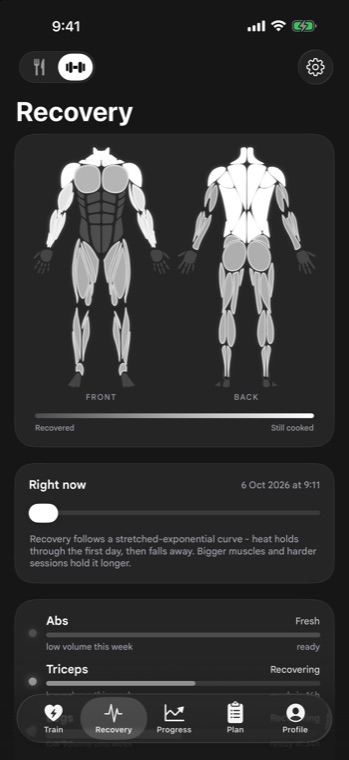
Modern recovery platforms like IMPOLS solve this through an intuitive Muscle Recovery Body Map. By analyzing every set, repetition, and volume load recorded in your workout tracker, the application maps localized fatigue across 14 distinct muscle groups on a visual anatomical model. Muscle groups transition from dark red (acute fatigue, 0-24 hours post-workout) to amber (remodeling, 24-48 hours) to vibrant green (supercompensated, 48-72 hours).
This localized map is synthesized with your nocturnal sleep score and HRV telemetry to calculate your daily Energy Bank. If your Energy Bank is at 90%, you are primed for intense progressive overload. If your Energy Bank is drained to 35% due to four hours of restless sleep and back-to-back training days, the app alerts you to implement intuitive training adjustments or take a restorative active recovery day.
5. Recovery and Sleep Optimization Comparison Matrix
The following table outlines the physiological impact and practical efficacy of common recovery modalities utilized by strength athletes:
| Recovery Modality | Primary Biological Mechanism | Impact on Muscle Hypertrophy | Systemic vs. Local Impact | Evidence-Based Rating |
|---|---|---|---|---|
| Optimized Nocturnal Sleep (7.5-9h) | Maximal HGH secretion, parasympathetic reactivation, MPS | Critical / Foundational; cannot be compensated for | Full systemic and central nervous system recovery | Tier 1 (Non-Negotiable) |
| Nutritional Glycogen & Protein Replenishment | mTORC1 activation, substrate resynthesis, positive nitrogen balance | Essential for repairing myofibrillar micro-tears | Systemic substrate delivery to damaged tissues | Tier 1 (Non-Negotiable) |
| Active Recovery (Low-Intensity Walking / Cycling) | Accelerates lymphatic drainage without inducing fatigue | Mild benefit; reduces perceived stiffness and DOMS | Localized peripheral blood flow enhancement | Tier 2 (High Value) |
| Cold Water Immersion / Ice Baths | Vasoconstriction, blunts acute inflammatory cascade | Negative; blunts anabolic signaling (mTORC1) post-lift | Acute peripheral inflammation suppression | Tier 4 (Avoid Post-Lifting) |
| Percussive Massage Guns / Foam Rolling | Transiently alters neural pain perception (gate control theory) | Neutral; does not accelerate structural tissue repair | Localized temporary relief of muscular tightness | Tier 3 (Contextual Comfort) |
6. Step-by-Step Protocol: The Ultimate Sleep Architecture Routine
To maximize slow-wave deep sleep and awaken with a fully recharged Energy Bank, execute this four-phase nocturnal protocol:
Phase 1: Circadian Anchoring (Morning & Afternoon)
Within 30 minutes of waking, expose your eyes to 10 to 15 minutes of natural sunlight (without sunglasses). Sunlight activates melanopsin-expressing retinal ganglion cells, synchronizing your suprachiasmatic nucleus (SCN) and setting an internal timer for nocturnal melatonin release 14 to 16 hours later. Establish a strict caffeine curfew: because caffeine has a half-life of 5 to 7 hours and a quarter-life of up to 12 hours, cease all caffeine consumption by 1:00 PM to prevent adenosine receptor blockade during deep sleep.
Phase 2: Pre-Bed Thermal and Environmental Priming
Human sleep onset requires a 1°C (2°F) drop in core body temperature. Take a hot shower or bath 60 to 90 minutes before bed: the hot water induces vasodilation in peripheral blood vessels (hands and feet), radiating heat away from your core once you step out. Set your bedroom thermostat to a cool 18°C to 20°C (65°F to 68°F), and ensure your sleeping environment is pitch black using blackout curtains or an eye mask.
Phase 3: Digital Sunset and Blue Light Mitigation
Two hours before sleep, initiate a “digital sunset.” The short-wavelength blue light emitted by smartphones, tablets, and LED televisions powerfully suppresses pineal melatonin secretion, delaying sleep onset and fragmenting slow-wave sleep. Switch devices to night mode, lower ambient room lighting, and engage in non-stimulating activities such as reading physical books or light mobility stretching.
Phase 4: Nocturnal Telemetry and Morning Readiness Review
Wear your smartwatch (Apple Watch or Wear OS) to sleep with sleep tracking active. Upon waking, open your recovery dashboard to review your deep sleep percentage, nocturnal resting heart rate, and HRV status. Use this objective data to dictate your training intensity for the day ahead.
7. Common Recovery Myths Debunked
Myth 1: “You Can Adapt to 5 Hours of Sleep”
Decades of sleep research from institutions like Stanford and Harvard prove conclusively that human beings cannot adapt to chronic sleep restriction without cognitive and physiological impairment. Trainees who claim they function perfectly on 5 hours have simply forgotten what it feels like to be biologically optimal; their hormonal profiles, reaction times, and anabolic signaling remain severely depressed.
Myth 2: “Ice Baths Right After Lifting Speed Up Recovery”
While plunging into an ice bath after a brutal workout reduces subjective muscle soreness, multiple randomized controlled trials show that post-workout cold water immersion significantly blunts long-term muscle hypertrophy and strength gains. Cold shock suppresses the acute inflammatory signaling pathways necessary to trigger muscle protein synthesis. Reserve ice baths for tournament athletics where immediate recovery supersedes muscle growth.
Myth 3: “Catching Up on Weekends Erases Sleep Debt”
Sleeping 10 hours on Saturday and Sunday does not reverse the metabolic damage or blunted muscle protein synthesis incurred by five consecutive days of sleep deprivation. Furthermore, erratic weekend sleep schedules disrupt your circadian pacemaker, creating “social jetlag” that impairs sleep quality on Sunday and Monday nights. Aim for consistent sleep and wake times seven days per week.
8. Frequently Asked Questions
How much deep sleep does a serious lifter need each night?
Most healthy adults spend 15% to 25% of their total sleep time in deep slow-wave sleep (SWS), which translates to approximately 75 to 120 minutes per night. Lifters undergoing heavy training blocks should target the upper end of this spectrum to facilitate optimal growth hormone release and connective tissue repair.
What should I do if my recovery score is low on a scheduled leg day?
Do not skip the gym entirely; instead, employ intuitive autoregulation. Reduce total volume by 25% to 30%, stop working sets at 2 to 3 RIR rather than grinding to failure, and focus on movement quality. This maintains neural familiarity and blood flow without overloading a compromised nervous system.
How does late-night eating affect sleep quality?
Consuming large, high-fat meals within two hours of bed forces your digestive tract to divert blood flow to the splanchnic circulation, elevating core body temperature and resting heart rate throughout the first half of the night. Aim to finish your final meal 2 to 3 hours before sleep, prioritizing moderate protein and complex carbohydrates to support nocturnal serotonin synthesis.
Can wearable sleep trackers accurately distinguish sleep stages?
While consumer wearables cannot replace clinical polysomnography (PSG) with EEG scalp electrodes, modern smartwatches from Apple and Samsung achieve remarkable accuracy by combining continuous optical PPG heart rate, HRV, skin temperature, and tri-axial accelerometry to identify transitions between light, deep, and REM sleep.
9. Summary and Recovery Implementation Checklist
Muscles do not grow in the gym; they are broken down in the gym and rebuilt in bed. By prioritizing sleep hygiene, monitoring autonomic readiness via HRV, and respecting your physiological Energy Bank, you create the ultimate internal environment for explosive strength and muscular growth.
- Commit to 7.5 to 9 hours of uninterrupted nocturnal sleep every night.
- Anchor your circadian rhythm with morning sunlight and enforce a 1:00 PM caffeine curfew.
- Keep your bedroom cool (18°C / 65°F) and completely dark to promote slow-wave sleep.
- Avoid post-workout ice baths to prevent blunting hypertrophic signaling cascades.
- Use an integrated sleep and recovery tracker to monitor your nocturnal HRV, resting heart rate, and Muscle Recovery Body Map.
- Align your daily lifting volume on your workout tracker with your biological Energy Bank score.