For decades, elite Olympic training centers and professional sports franchises relied on linear position transducers and optical laser units costing thousands of dollars to implement Velocity-Based Training (VBT). These bulky laboratory devices clamped onto barbells with retractable steel cables, measuring concentric velocity in meters per second (m/s). For ordinary gym lifters and private fitness enthusiasts, the cost and logistical complexity made VBT an unattainable fantasy. Today, a technological revolution has occurred. High-frequency micro-electro-mechanical systems (MEMS), including tri-axial accelerometers and gyroscopes embedded directly inside consumer smartwatches (Apple Watch and Wear OS), now deliver laboratory-grade kinematic telemetry right from your wrist. When paired with an intelligent intuitive training platform, every lifter can harness the power of velocity-based autoregulation without spending thousands of dollars on specialized laboratory equipment.
In this comprehensive operational guide, we dissect the physics of mean concentric velocity (MCV), analyze velocity loss thresholds, contrast peak velocity with mean propulsive velocity, explore how wrist-mounted sensors capture barbell kinematics, and outline an actionable protocol to integrate VBT into your daily sessions using your workout tracker.
1. The Physics of Velocity: Why Speed Is the Ultimate Truth
In conventional resistance training, lifters judge their sets using two numbers: the load on the bar and the number of repetitions completed. What this leaves out is the kinematics of execution. A set of 5 repetitions with 100 kg where every repetition explodes at 0.70 m/s represents an entirely different neuromuscular stimulus than a set of 5 repetitions where the final three reps grind at 0.22 m/s.
Concentric velocity is directly governed by Newton’s Second Law of Motion (Force = Mass × Acceleration). In skeletal muscle, maximal force output decreases as shortening velocity increases (the classical Hill Force-Velocity Relationship). However, for a given fixed mass on the barbell, the velocity at which you move the load reflects the exact percentage of your true maximal neuromuscular recruitment at that moment.
Extensive research by Dr. Juan José González-Badillo and colleagues demonstrated that the relationship between relative load (% of 1RM) and Mean Concentric Velocity (MCV) is extraordinarily stable across different athletes and training sessions. For example, on the barbell back squat:
- 100% 1RM (Maximal Effort): ~0.30 m/s (The Minimum Velocity Threshold, or MVT)
- 90% 1RM (Heavy Strength): ~0.42 to 0.46 m/s
- 80% 1RM (Hypertrophic Zone): ~0.55 to 0.60 m/s
- 70% 1RM (Sub-Maximal Strength): ~0.70 to 0.75 m/s
- 60% 1RM (Speed-Strength): ~0.85 to 0.95 m/s
Because these velocity profiles are mathematically constant, your concentric speed tells you your exact percentage of 1RM today, completely independent of how much weight you tested six months ago.
2. Mean Concentric Velocity (MCV) vs. Mean Propulsive Velocity (MPV)
When diving into VBT literature, understanding the difference between velocity metrics prevents inaccurate data interpretation:
1. Mean Concentric Velocity (MCV)
MCV measures the average speed across the entire concentric phase of the lift, from the lowest turning point to the complete lockout. For heavy loads (>75% 1RM), MCV is exceptionally accurate because the lifter must apply force through almost the entire range of motion.
2. Mean Propulsive Velocity (MPV)
With lighter loads (<60% 1RM), lifters must decelerate the barbell at the end of the movement to prevent the bar from flying out of their hands or jarring their joints. During this braking phase, acceleration becomes negative. MPV measures only the portion of the concentric phase where acceleration is greater than gravity (acceleration > -9.81 m/s²). Smartwatch algorithms automatically account for this braking phase when analyzing sub-maximal explosive sets.
3. Velocity Loss Thresholds: Hypertrophy vs. Maximal Power
The most powerful practical application of VBT is Intra-Set Velocity Loss Monitoring. Rather than performing a fixed number of repetitions (e.g., 3 sets of 10), you perform repetitions until bar speed drops by a predetermined percentage relative to your fastest repetition.
The following table demonstrates how velocity loss dictates neuromuscular adaptations and systemic fatigue:
| Velocity Loss Cut-Off | Neuromuscular Stimulus Focus | Proximity to Failure (RIR) | Metabolic Fatigue & CNS Penalty | Optimal Athletic Application |
|---|---|---|---|---|
| 5% to 10% Velocity Loss | Maximal Neuromuscular Power & Speed | 5+ RIR (Highly explosive) | Negligible metabolic waste; zero soreness | Sprinters, Olympic weightlifters, power peaking |
| 15% to 20% Velocity Loss | Maximal Strength Development | 3 to 4 RIR (Sub-maximal tension) | Low fatigue; high movement efficiency | Strength phases, in-season athletic maintenance |
| 25% to 35% Velocity Loss | Optimal Muscular Hypertrophy | 1 to 2 RIR (Stimulating reps) | Moderate, manageable fatigue | Bodybuilders, off-season hypertrophy blocks |
| 40% to 50%+ Velocity Loss | Metabolic Exhaustion / Failure | 0 RIR (Absolute muscular failure) | Extreme fatigue; heavy muscle damage | Final burnout sets; dangerous on spinal compound lifts |
4. How Consumer Smartwatches Replace $2,000 Laboratory Hardware
Historically, lifters believed that accurate VBT required a linear encoder bolted to the floor with a tether wire connected to the bar. However, modern computational mechanics and high-rate sensor polling have changed the paradigm completely.
Modern smartwatches house high-grade 6-axis IMUs containing tri-axial accelerometers and gyroscopes capable of sampling at 100 to 200 Hz (100 to 200 measurements per second). When you grip a barbell during a bench press or squat, your wrist moves in direct mechanical lockstep with the bar path.
By applying a digital high-pass filter (to remove gravity bias) followed by double integration of acceleration over time, the algorithm reconstructs the exact vertical velocity curve and displacement. High-frequency validation studies show that wrist-mounted IMU sensors achieve over 95% correlation with commercial optical linear transducers when tracking barbell pressing and squatting movements, delivering laboratory-level feedback directly to your wrist.
5. Step-by-Step Protocol: Executing a Velocity-Governed Gym Session
To implement velocity-based training without expensive hardware, execute this 4-phase protocol:
Phase 1: Routine Pre-Configuration and Baseline Profiling
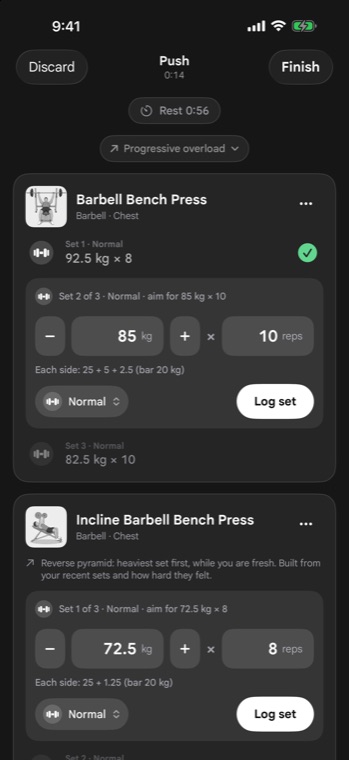
Open your workout tracker and select your primary compound lift (e.g., Barbell Bench Press). Set your target load (e.g., 100 kg) and assign a 30% velocity loss threshold for hypertrophy. Pair your smartwatch (Apple Watch or Wear OS) via Bluetooth.
Phase 2: The First Working Repetition (Establishing the Velocity Benchmark)
Un-rack the bar and execute your first working repetition with 100% maximal concentric acceleration. Never lift the bar slowly on purpose; push through the bar with maximal explosive intent. Your watch records the peak and mean velocity of rep one (e.g., 0.62 m/s). This establishes your session benchmark.
Phase 3: Real-Time Haptic Set Termination
Continue performing repetitions. As muscle fibers fatigue, bar speed will steadily decline: rep 2 at 0.60 m/s, rep 3 at 0.56 m/s, rep 4 at 0.51 m/s, rep 5 at 0.44 m/s. When repetition 6 drops to 0.43 m/s (surpassing the 30% velocity loss threshold), your smartwatch emits a crisp, prominent haptic pulse alerting you that you have captured the full hypertrophic stimulus. Re-rack the barbell immediately.
Phase 4: Autoregulating Rest and Working Sets
Your watch automatically begins your programmed rest countdown. Because you terminated the set at 30% velocity loss rather than grinding to sloppy failure, neuromuscular recovery is rapid. You execute your subsequent sets with high movement quality, accumulating clean, high-tension volume without unrecovered joint trauma.
6. Common Velocity-Based Training Pitfalls
Pitfall 1: Failing to Apply Maximal Concentric Intent
VBT relies entirely on the premise that you are attempting to move the load as fast as possible on every repetition. If you intentionally lift the barbell slowly (e.g., using a 3-second concentric tempo), velocity metrics lose all validity. Control the eccentric lowering phase smoothly, then explode through the concentric phase with maximal intent.
Pitfall 2: Altering Movement Technique to Maintain Velocity
As fatigue accumulates, lifters sometimes cut their squat depth, bounce the bar off their chest, or hitch their hips to keep bar speed high. A repetition performed with degraded technique is an invalid data point. Velocity loss must be tracked under identical, pristine biomechanical form.
Pitfall 3: Applying VBT to Isolation Exercises
VBT is engineered for multi-joint compound movements (Squats, Bench Presses, Deadlifts, Overhead Presses, Rows) where barbell displacement follows a consistent linear path. Applying VBT to dumbbell lateral raises, bicep curls, or cable flyes is inaccurate due to rotational joint mechanics and variable leverage arcs. Track isolation movements using standard Reps in Reserve (RIR) in your workout tracker.
7. Integrating VBT with Daily Readiness and Nocturnal Sleep
The ultimate power of velocity tracking emerges when paired with nocturnal biological monitoring. On days when your nocturnal Heart Rate Variability (HRV) is elevated and your sleep score is high on your sleep tracker, your warm-up velocity will naturally reflect this supercompensation.
If your standard warm-up with 80 kg moves at 0.78 m/s instead of your usual 0.70 m/s, your central nervous system is firing with exceptional readiness. This is your cue to push working weights higher. Conversely, if 80 kg feels heavy and moves at only 0.62 m/s, your system is carrying fatigue; respect the data, autoregulate the load downward, and preserve your joints.
7b. Daily 1RM Estimation: Eliminating Testing Day Fatigue
One of the most profound benefits of VBT is the ability to calculate an accurate daily 1RM without ever performing a maximal single. Because the load-velocity relationship is a straight linear regression, plotting two or three warm-up sets (e.g., 60 kg at 0.85 m/s, 80 kg at 0.70 m/s, and 100 kg at 0.55 m/s) allows the algorithm to project the exact load where velocity intersects the Minimum Velocity Threshold (0.30 m/s).
This projected 1RM gives you an exact daily benchmark for your working sets, completely eliminating the systemic fatigue, joint pain, and injury risk associated with true maximal 1RM testing.
7c. Individual Velocity Profiles (IVP): Customizing the Curve
While generic velocity tables provide excellent starting baselines, elite strength athletes construct an Individual Velocity Profile (IVP). Every human body possesses unique anthropometrics: a lifter with long femurs will traverse a longer displacement on the squat, while an athlete with short arms will display a shorter, faster bench press stroke.
By logging your lifts across multiple sessions in your workout tracker, the platform calculates your personal linear regression equation. This custom mathematical curve personalizes your exact daily 1RM and velocity loss thresholds with over 98% accuracy, providing customized telemetry that reflects your unique biomechanics.
7d. Barbell Path Tracking and Horizontal Drift Analysis
True lifting efficiency requires that force is applied vertically against gravity. On exercises like the bench press or squat, excessive horizontal drift represents wasted mechanical energy and increased joint shear.
Using 6-axis IMU sensor fusion, your smartwatch monitors not just vertical velocity, but three-dimensional rotational drift. If your bar path deviates significantly from your optimal groove, the app displays a visual warning, helping you correct technical inefficiencies before they manifest as failed repetitions or joint pain. Maintaining an efficient bar path minimizes lever arm strain on the anterior deltoids and lumbar spine, allowing lifters to transmit maximal contractile force directly into barbell acceleration.
7e. The Minimal Velocity Threshold and True Concentric Failure
Understanding your exact Minimal Velocity Threshold (MVT) transforms how you approach heavy sets. When bar speed reaches MVT (e.g., 0.18 m/s on bench press), the lifter knows with mathematical certainty that zero additional repetitions can be completed without a spotter. This objective boundary eliminates unnecessary missed repetitions and protects lifters from hazardous barbell pinches.
8. Frequently Asked Questions
Can I do VBT with dumbbells?
Yes. Because the smartwatch sits on your wrist, tracking dumbbell presses, lunges, and rows is fully supported. Keep in mind that dumbbell movements carry slightly higher trajectory variance than barbells, so focus on the trend across multiple repetitions.
Does VBT work for building pure muscle, or is it only for power athletes?
VBT is exceptional for hypertrophy. Setting a 30% to 35% velocity loss cap guarantees that every set is terminated right in the high-tension hypertrophic pocket (1-2 RIR) while preventing unproductive junk volume.
How does nutrition impact concentric bar velocity?
Intramuscular glycogen availability directly fuels anaerobic glycolysis. If you cut carbohydrates too aggressively on your macro tracker, intracellular calcium cycling slows, causing bar speed to decay prematurely.
What is the minimum velocity threshold (MVT)?
MVT is the slowest possible speed at which you can complete the concentric phase of a lift before failing. For the squat it is ~0.30 m/s, for the bench press ~0.18 m/s, and for the conventional deadlift ~0.15 m/s.
9. Summary and VBT Implementation Checklist
Velocity-Based Training is no longer locked inside elite sports science labs. By unlocking the high-frequency inertial sensors in your smartwatch, you gain an objective, real-time coach on your wrist that eliminates guesswork and maximizes strength gains.
- Lift with 100% maximal concentric intent on every repetition.
- Use a 15% to 20% velocity loss cap for strength, and 25% to 35% for muscular hypertrophy.
- Standardize your movement technique to maintain kinematic data integrity.
- Track barbell movements using your smartwatch (Apple Watch or Wear OS) and pair with your digital workout tracker.
- Autoregulate daily loads based on warm-up velocity and nocturnal recovery on your sleep tracker.