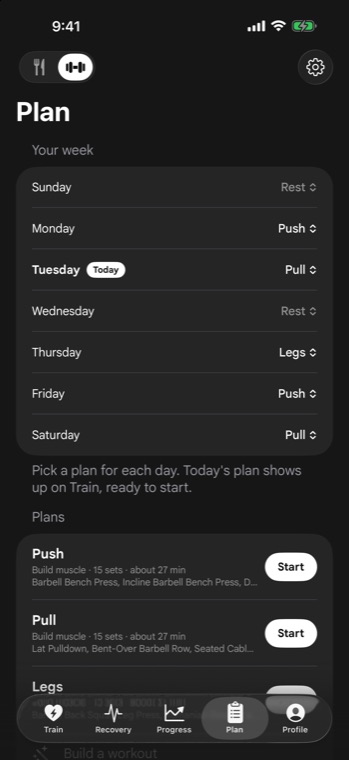
Among all workout split architectures in the history of physical culture, the Push-Pull-Legs (PPL) split stands out as arguably the most logically balanced, versatile, and biomechanically sound framework ever created. Unlike arbitrary body-part “bro splits” that isolate chest on Monday, back on Tuesday, and arms on Friday, the PPL split organizes training around fundamental human kinetic movement patterns. By grouping muscles that function synergistically together (pushing muscles on one day, pulling muscles on the next, and lower body on the third), PPL virtually eliminates overlapping joint friction, optimizes recovery kinetics, and allows lifters to hit each muscle group with optimal frequency (two times per week in a 6-day split or rotating cycles). When tracked using a modern workout tracker, the PPL split provides an unbeatable framework for progressive overload.
In this definitive programming guide, we dissect the biomechanical foundations of movement-based splits, contrast 3-day, 4-day, and 6-day PPL variations, outline exact exercise selections and rep brackets, solve the problem of spinal fatigue accumulation, and provide an actionable double-progression protocol paired with your companion smartwatch sensors.
1. The Biomechanical Logic: Movement Patterns vs. Muscle Groups
The fundamental flaw of traditional bodybuilding splits is their neglect of kinetic synergy. For example, if you perform heavy chest pressing on Monday, heavy shoulder pressing on Tuesday, and triceps pressdowns on Wednesday, your anterior deltoids and triceps brachii are subjected to severe mechanical stress three days in a row without a single 48-hour recovery window. This chronic joint irritation frequently manifests as anterior shoulder impingement or distal triceps tendinopathy.
The Push-Pull-Legs split eliminates this problem by aligning with anatomical movement patterns:
- Push Day (Upper Body Horizontal & Vertical Extension): Pectoralis Major, Anterior Deltoids, Lateral Deltoids, and Triceps Brachii. All pressing muscles contract together as prime movers and synergistic stabilizers. Once the Push workout concludes, all pushing joints and muscles rest for a full 72 to 96 hours.
- Pull Day (Upper Body Horizontal & Vertical Flexion): Latissimus Dorsi, Trapezius, Rhomboids, Posterior Deltoids, Biceps Brachii, Brachialis, Brachioradialis, and Spinal Erectors. Pulling muscles work in synergy to retract and depress the scapulae and flex the elbows without stressing the anterior shoulder capsule.
- Leg Day (Lower Body Anterior & Posterior Chain): Quadriceps, Gluteus Maximus, Hamstrings, Adductors, and Calves. By dedicating an entire session to the lower body, the upper body experiences complete systemic rest while the largest muscle groups in the human body are stimulated under high mechanical tension.
2. PPL Split Variations: 6-Day vs. Rotating vs. 3-Day
The optimal weekly scheduling of PPL depends on an athlete’s training age, work schedule, and biological recovery capacity:
1. The Classic 6-Day Split (PPLPPLR)
The 6-day split runs Push A, Pull A, Legs A, followed by Push B, Pull B, Legs B, and one dedicated rest day on Sunday. This variation provides high weekly frequency (each muscle trained every 3 to 4 days) and high weekly volume (16 to 24 sets per muscle group). It is the gold standard for intermediate to advanced lifters possessing excellent sleep and high caloric support.
2. The Rotating 5-Day Asynchronous Split (PPL-Rest-PPL-Rest)
For natural lifters with intense professional careers or demanding life stressors, the rigid 6-day schedule can accumulate excessive central nervous system fatigue. The rotating schedule trains three days on, one day off, continuously. This spreads the sessions across an 8-day rolling cycle, providing 33% more recovery days while preserving optimal twice-per-week frequency.
3. The Minimalist 3-Day Split (Push / Rest / Pull / Rest / Legs / Rest / Rest)
For beginners or busy executives who can only dedicate three gym sessions per week, the 3-day PPL provides a clean, focused environment where each session is executed with maximal intensity and zero overlapping fatigue.
3. Complete Master PPL Workout Templates (Workout A & Workout B)
To avoid repetitive strain and stimulate muscle fibers across varying angles, program two distinct workouts for each movement pattern across the week:
| Session | Primary Compound Lift | Secondary Compound Lift | Accessory & Isolation Movements | Target Volume & RIR |
|---|---|---|---|---|
| Push A (Chest Dominant) | Flat Barbell Bench Press (3×6-8) | Incline Dumbbell Press (3×8-10) | Cable Lateral Raise (4×12-15), Overhead Triceps Rope Extension (3×10-12) | 13 Working Sets (1-2 RIR) |
| Pull A (Vertical Dominant) | Weighted Neutral-Grip Pull-Up (3×6-8) | Chest-Supported T-Bar Row (3×8-10) | Rear Delt Dumbbell Flye (4×12-15), Incline Dumbbell Bicep Curl (3×10-12) | 13 Working Sets (1-2 RIR) |
| Legs A (Quad Dominant) | Barbell Back Squat (3×6-8) | Romanian Deadlift (3×8-10) | Leg Press (3×10-12), Seated Leg Curl (3×12-15), Standing Calf Raise (4×12-15) | 16 Working Sets (2 RIR) |
| Push B (Shoulder Dominant) | Standing Barbell Overhead Press (3×6-8) | Flat Dumbbell Bench Press (3×8-10) | Incline Cable Flye (3×12-15), Triceps Straight Bar Pushdown (4×10-12) | 13 Working Sets (1-2 RIR) |
| Pull B (Horizontal Dominant) | Barbell Bent-Over Row (3×6-8) | Close-Grip Lat Pulldown (3×8-10) | Cable Face Pulls (4×15-20), Barbell EZ-Bar Spider Curl (3×10-12) | 13 Working Sets (1-2 RIR) |
| Legs B (Posterior Dominant) | Trap Bar Deadlift (3×5-7) | Hack Squat (3×8-10) | Walking Dumbbell Lunge (3×10/leg), Lying Leg Curl (3×10-12), Seated Calf Raise (4×15) | 16 Working Sets (2 RIR) |
4. Solving the Spinal Loading Dilemma in PPL Programming
The single greatest operational pitfall of the Push-Pull-Legs split is accumulated axial fatigue on the lumbar spine. In poorly designed PPL routines, an athlete performs heavy Barbell Bent-Over Rows on Pull Day, followed immediately by Barbell Back Squats and Romanian Deadlifts on Leg Day.
Because the spinal erectors require 72 hours to fully clear neuromuscular fatigue, forcing heavy squats immediately after heavy bent-over rows places an unrecovered lumbar spine under extreme compressive and shear loads. This leads to technique breakdown, “good morning” squat mechanics, and eventual lower back spasms.
To eliminate this hazard, deploy Axial Alternation:
- On days preceding heavy squats, substitute free-weight barbell rows with chest-supported machine rows or chest-supported T-bar rows. These isolate the mid-back and lats without requiring any spinal erector isometric bracing.
- Pair your heavy deadlift variation with Hack Squats or Leg Presses rather than pairing deadlifts with barbell back squats in the same 48-hour window.
5. Step-by-Step Protocol: The Double-Progression Engine
To ensure consistent progressive overload week after week without burning out, govern your PPL mesocycle using the Dynamic Double-Progression Protocol in your workout tracker:
Phase 1: Assign Repetition Brackets and RIR Stop-Points
Assign every exercise an explicit rep bracket and RIR target rather than a static repetition count (e.g., Incline Dumbbell Press: 3 sets of 8 to 10 repetitions at 2 RIR). Never increase the weight until you satisfy the top end of the rep bracket across all working sets.
Phase 2: Volume Progression Within the Bracket
In Week 1 with 32 kg dumbbells, your performance might look like: Set 1 = 10 reps, Set 2 = 9 reps, Set 3 = 8 reps. In Week 2, your goal is to add repetitions: Set 1 = 10 reps, Set 2 = 10 reps, Set 3 = 9 reps. In Week 3, you achieve Set 1 = 10 reps, Set 2 = 10 reps, Set 3 = 10 reps. You have now conquered the bracket.
Phase 3: The Systematic Load Increment
Once you achieve the maximum target reps (10, 10, 10) while maintaining your 2 RIR buffer, increase the external resistance by the smallest available increment (e.g., from 32 kg to 34 kg dumbbells). Your reps on the next session will naturally drop back toward the bottom of the bracket (e.g., 8, 8, 7 reps). You then repeat the process, systematically building reps before adding weight.
Phase 4: Mesocycle Deloading Every 6th to 8th Week
After six consecutive weeks of heavy double progression, systemic fatigue will begin masking your fitness. Schedule a 1-week deload: reduce working sets by 50% and terminate every set at an easy 4 RIR. This clears connective tissue inflammation and resets neurological sensitivity for your next PPL block.
6. Common PPL Programming Mistakes
Mistake 1: Undertraining the Rear Deltoids and Lateral Deltoids
Many lifters perform massive pressing volume on Push Day, over-developing the anterior deltoids while neglecting the lateral and rear heads. To build true 3D shoulder symmetry, include dedicated lateral raises on Push Day and face pulls or rear delt flyes on Pull Day.
Mistake 2: Neglecting Lower Body Intensity
Because Leg Day is metabolically brutal, lifters often cut leg workouts short or skip Leg Day entirely, leading to upper-lower physical imbalances. Treat Leg Day with identical discipline and tracking as Push and Pull days.
Mistake 3: Skipping Programmed Rest Days
Enthusiastic lifters often attempt to run PPL continuously for 14 or 21 days straight without taking a single rest day. The central nervous system and immune system cannot tolerate continuous high-load training without systemic rest; take your programmed rest days to allow biological supercompensation.
7. Integrating PPL with Wearable Sensors and Autoregulation
Pairing your PPL workouts with a smartwatch (Apple Watch or Wear OS) elevates your split to elite precision. Haptic rest timers ensure you never rest too long on busy gym days, and accelerometer velocity tracking monitors concentric bar speed to ensure your 2 RIR target is maintained without subjective guesswork.
Furthermore, reviewing your daily recovery on your sleep tracker before your session helps you decide whether today is the day to push the top end of your double-progression bracket or hold the line to avoid overreaching.
7b. Nutritional Periodization for Push, Pull, and Leg Days
Because energy expenditure varies drastically between a 16-set Leg workout and a 13-set Push workout, intelligent athletes match their nutritional intake to the demands of each day. Aligning high-carbohydrate days on your macro tracker with Leg Day and Pull Day provides the glycogen necessary for heavy multi-joint lifts, while dropping carbs on rest days keeps body composition lean and defined.
7c. Periodizing Arm and Abdominal Direct Volume in PPL
A frequent debate in PPL programming is where to place direct bicep, triceps, and abdominal training. Because biceps are heavily recruited during back pulls and triceps during chest presses, performing 3 to 4 direct isolation sets at the tail end of Pull and Push days ensures complete muscular exhaustion without interfering with subsequent recovery windows.
7d. Grip Fatigue and Forearm Management on Pull Days
A frequent hidden bottleneck on heavy Pull sessions is grip fatigue. When performing heavy weighted pull-ups, barbell rows, and Romanian deadlifts back-to-back, the flexor digitorum superficialis and profundus muscles of the forearms undergo prolonged isometric tension.
If your grip begins to give out on set 2 of barbell rows, your central nervous system initiates protective neural inhibition, blunting motor unit firing in the latissimus dorsi and rhomboids. To ensure that your back musculature receives a maximal hypertrophic stimulus, utilize high-durability lifting straps or figure-8 straps on your heaviest compound pulling sets. Reserve raw grip work for dedicated forearm training or specialized grip hangs at the very end of your workout, ensuring grip strength never limits back development in your workout tracker.
8. Frequently Asked Questions
Is a 6-day PPL split too much volume for a natural lifter?
Not if per-session volume is managed. A well-designed PPL session contains only 12 to 16 total working sets. Natural lifters thrive on this split because it provides twice-per-week frequency per muscle group, which maintains elevated muscle protein synthesis throughout the week.
Can I do PPL as a 4-day split?
Yes. You can rotate through the split sequentially over four training days per week (e.g., Week 1: Push, Pull, Legs, Push; Week 2: Pull, Legs, Push, Pull). The cycle naturally rolls across calendar weeks.
Where should I program deadlifts in PPL?
Conventional or trap bar deadlifts fit best on Pull Day or Legs Day, depending on your focus. If on Pull Day, perform them first; if on Legs Day, use Romanian Deadlifts as a primary hamstring builder.
How long should a standard PPL gym session take?
A focused PPL workout comprising 12 to 16 high-intensity working sets with standardized 90 to 180-second rest intervals should take approximately 60 to 75 minutes.
9. Summary and PPL Master Checklist
The Push-Pull-Legs split provides the ultimate balance of movement pattern synergy, muscular frequency, and structural recovery. By tracking your sets and weights with double progression, you unlock steady, continuous athletic progress.
- Organize workouts by kinetic movement patterns to prevent chronic anterior shoulder strain.
- Choose between 6-day, rotating, or 3-day variations based on your recovery capacity.
- Deploy Axial Alternation to prevent lower back and spinal erector burnout.
- Use Dynamic Double Progression to systematically increase reps before adding external weight.
- Govern rest intervals and sets using your smartwatch (Apple Watch or Wear OS).
- Log all workouts in a dedicated workout tracker, match daily carbohydrates on your food tracker, and monitor biological readiness on your sleep tracker.