In the hierarchy of athletic performance, resistance training provides the mechanical stimulus, nutrition provides the chemical building blocks, but sleep is the biological operating system in which all adaptation takes place. Millions of dedicated lifters invest thousands of dollars into high-protein diets, specialized supplements, gym memberships, and lifting gear, yet sabotage their physique by chronically sleeping five to six hours per night. Many wear sleep deprivation as a badge of honor, parroting misguided slogans like “I will sleep when I am dead.” Contemporary exercise endocrinology and sports medicine paint a terrifying counter-reality: chronic sleep restriction actively dismantles skeletal muscle, accelerates visceral fat gain, crushes androgenic hormone production, and impairs motor unit recruitment. If you are not sleeping adequately, you are not merely compromising your gains: you are training in a state of self-induced catabolism.
In this scientific deep dive, we examine the molecular and endocrine pathways through which sleep loss destroys muscle growth, analyze testosterone-to-cortisol ratios, dissect slow-wave sleep (SWS) and growth hormone secretion, explore sleep architecture metrics, and provide an actionable protocol to optimize your sleep using a companion sleep tracker and workout tracker.
1. The Endocrine Disaster: Testosterone, Cortisol, and IGF-1
The primary mechanism through which sleep deprivation impairs muscular hypertrophy is the catastrophic disruption of the endocrine system. The human hormonal cascade is regulated by rhythmic circadian oscillations that require consolidated, unfragmented sleep.
1. The Testosterone Collapse
In healthy men, the vast majority of daily testosterone secretion occurs during sleep, specifically during REM sleep cycles. In a landmark study published in the Journal of the American Medical Association (JAMA) by Dr. Eve Van Cauter and colleagues, healthy young men were restricted to five hours of sleep per night for just one single week. The biological results were staggering: daytime testosterone levels plummeted by 10% to 15%. A reduction of this magnitude represents the biological equivalent of aging 10 to 15 years in a single week. For lifters attempting to build muscle or maintain high force output in their workout tracker, this hormonal drop suppresses myogenic signaling and blunts protein synthesis.
2. Hypercortisolemia and Muscle Protein Breakdown
As testosterone drops, circulating cortisol (the primary catabolic glucocorticoid) surges. Sleep deprivation disrupts the hypothalamic-pituitary-adrenal (HPA) axis, preventing the normal evening downregulation of cortisol. Elevated cortisol exerts direct catabolic effects on skeletal muscle: it binds to glucocorticoid receptors, upregulating the ubiquitin-proteasome pathway (specifically the muscle-specific E3 ubiquitin ligases MuRF1 and MAFbx/Atrogin-1), which actively tag contractile myofibrillar proteins for degradation.
3. Blunted Growth Hormone (GH) and IGF-1 Pulsatility
Approximately 60% to 70% of daily human growth hormone (hGH) is secreted in large nocturnal pulses during the deepest stages of non-REM sleep (Stage 3 Slow-Wave Sleep). Slow-wave sleep serves as the primary restorative window for musculoskeletal tissues. Restricting sleep duration or fragmenting sleep architecture truncates slow-wave sleep, blunting GH release and impairing downstream hepatic production of Insulin-like Growth Factor 1 (IGF-1), the master driver of satellite cell proliferation and muscle repair.
2. The Nedeltcheva Study: Losing Muscle Instead of Fat
Perhaps the most alarming study on sleep and body composition was conducted by Dr. Arlet Nedeltcheva and published in the Annals of Internal Medicine. Researchers placed overweight adults on a standardized, moderate caloric deficit under two distinct conditions: 8.5 hours of sleep per night versus 5.5 hours of sleep per night.
Both groups lost an identical total amount of weight (~3.0 kg) because their calories and macros were strictly clamped. However, the composition of the weight lost was horrifyingly different:
- In the 8.5-Hour Sleep Group: Over 50% of the weight lost was pure adipose tissue (fat), while lean mass was preserved.
- In the 5.5-Hour Sleep Group: A staggering 80% of the weight lost was lean muscle mass, and fat loss dropped by 55%!
When you are sleep-deprived in a caloric deficit, your body enters an evolutionary starvation panic. It perceives insufficient recovery as an existential crisis, downregulating high-energy contractile muscle tissue while stubbornly clinging to adipose energy reserves. In short, sleep deprivation turns a successful cutting phase into metabolic self-cannibalization.
3. Comparison Table: Rested vs. Sleep-Deprived Athlete Telemetry
The following table contrasts key physiological markers between a well-rested lifter (8+ hours) and an acutely sleep-deprived lifter (<6 hours):
| Biomarker / Metric | Well-Rested Athlete (8+ Hours) | Sleep-Deprived Lifter (<6 Hours) | Physiological Consequence |
|---|---|---|---|
| Daytime Testosterone | Optimal physiological peak | Suppressed by 10% to 15%+ | Blunted myogenic signaling and protein accretion |
| Resting Cortisol | Low, healthy diurnal decline | Elevated, flat evening slope | Accelerated muscle protein breakdown (MuRF1) |
| Growth Hormone (hGH) | Robust nocturnal slow-wave pulses | Truncated / fragmented pulses | Impaired joint, collagen, and tendon remodeling |
| Insulin Sensitivity | High peripheral glucose uptake | Clinically pre-diabetic state (-30%) | Nutrient partitioning shifts toward adipose storage |
| Motor Unit Recruitment | Fast rate of force development (RFD) | Delayed voluntary neural drive | Concentric bar speed slows; high perceived exertion |
| Appetite Hormones | Balanced leptin and ghrelin | Low leptin (-18%), high ghrelin (+28%) | Intense cravings for hyper-palatable junk food |
4. Impaired Glycogen Resynthesis and Neuromuscular Drive
Sleep restriction also directly cripples gym performance through metabolic and neurological pathways:
1. Muscle Glycogen Resynthesis Failure
Following a hard lifting session, skeletal muscle relies on nocturnal rest to replenish intracellular glycogen stores. Sleep deprivation induces acute peripheral insulin resistance in skeletal muscle cells: GLUT4 glucose transporters become unresponsive to circulating insulin. Even if you consume ample carbohydrates on your macro tracker, glucose uptake into muscle tissue is blunted, leaving glycogen stores half-empty for your next workout.
2. Central Nervous System (CNS) Latency
Maximal strength expression depends on the firing rate and synchronization of alpha motor neurons. Sleep loss causes synaptic adenosine accumulation in the prefrontal cortex and motor cortex. This results in central neuromuscular inhibition: your brain physically cannot generate maximal voluntary contraction (MVC) velocity. Lifts that normally feel light move sluggishly, and sets terminate prematurely due to central neural fatigue rather than true peripheral muscular capacity.
5. Step-by-Step Protocol: Engineering the Ultimate Sleep Architecture
To reverse sleep debt and unlock maximum hypertrophic adaptation, execute this 4-phase sleep hygiene protocol:
Phase 1: Circadian Phototherapy and Cortisol Entrainment
Within 30 minutes of waking, expose your eyes to 10 to 20 minutes of natural outdoor sunlight without sunglasses. This photon influx activates intrinsically photosensitive retinal ganglion cells (ipRGCs), resetting your hypothalamic master clock, triggering a healthy morning cortisol surge, and establishing a 16-hour countdown for nocturnal melatonin release.
Phase 2: Adenosine Optimization and Caffeine Curfews
Adenosine is the biochemical driver of “sleep pressure” that builds up in the brain during waking hours. Caffeine acts as an adenosine receptor antagonist: it does not eliminate fatigue, it simply blocks the receptors. Because caffeine has an average half-life of 5 to 7 hours and a quarter-life of up to 12 hours, consuming pre-workout caffeine after 2:00 PM severely fragments deep slow-wave sleep. Implement a strict caffeine cut-off at least 9 hours before your target bedtime.
Phase 3: Thermal Dysregulation Prevention
To initiate sleep, your core body temperature must drop by approximately 1°C (2 to 3°F). A hot bedroom impairs vasodilation and causes nocturnal restlessness. Set your bedroom thermostat to 65°F to 68°F (18°C to 20°C). Taking a hot shower 60 minutes before bed causes blood vessels in your hands and feet to dilate, radiating heat away from your core and accelerating sleep onset latency.
Phase 4: Objective Sleep Architecture Tracking
Wear your smartwatch (Apple Watch or Wear OS) to bed each night to track sleep staging: Deep (Slow-Wave) Sleep, REM Sleep, Light Sleep, and wake events. Aim for at least 90 minutes of Deep Sleep and 90 to 120 minutes of REM Sleep per night. Sync these metrics with your recovery tracker to guide your daily training intensity.
6. Common Sleep Hygiene Mistakes Made by Lifters
Mistake 1: Relying on Alcohol as a Sleep Aid
While alcohol acts as a sedative that induces rapid unconsciousness, sedation is not biological sleep. Alcohol is a powerful REM and slow-wave sleep suppressor. Even two drinks metabolized during the night fragments sleep architecture, elevates nocturnal heart rate, and obliterates growth hormone secretion.
Mistake 2: Eating Massive High-Fat Meals Right Before Bed
Digesting heavy fats requires significant metabolic energy, raising nocturnal core body temperature and diverting blood away from musculoskeletal repair to gastrointestinal organs. Finish your final dinner 2 to 3 hours before bed; if you need pre-bed protein, opt for low-fat micellar casein or non-fat Greek yogurt.
Mistake 3: Looking at High-Intensity Blue Screens
Blue wavelength light (450 to 480 nm) emitted by smartphones and laptops suppresses nocturnal melatonin secretion by over 80%. Use blue-blocking glasses or activate night shift modes two hours before bed to safeguard your natural hormonal cascade.
7. Autoregulating Training After a Bad Night of Sleep
Despite best efforts, occasional bad nights of sleep happen due to travel, family emergencies, or work demands. In modern intuitive training, you do not force a high-volume personal record workout on three hours of sleep.
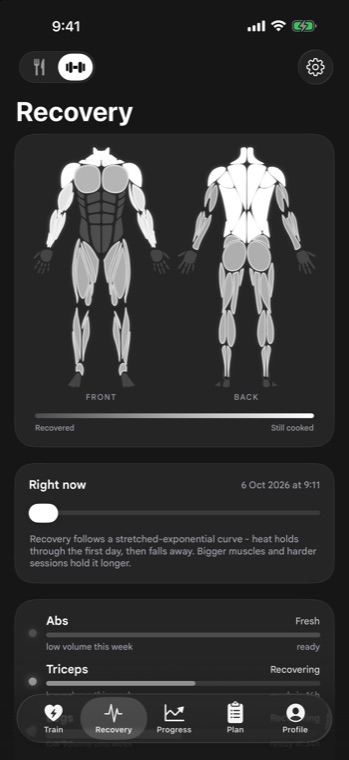
When your nocturnal HRV drops and your Energy Bank is drained, autoregulate your session: maintain your planned exercises, but reduce working sets by 40%, eliminate sets taken to failure, and stop all sets at 2 to 3 RIR in your workout tracker. This stimulates muscle protein synthesis without pushing your sleep-deprived nervous system into injury or clinical overtraining.
7b. Sleep Extension and Athletic Supercompensation
Groundbreaking research conducted at Stanford University by Cheri Mah demonstrated that extending sleep from 7 hours to 9 or 10 hours per night in collegiate athletes led to dramatic improvements in sprint speed, reaction time, bench press endurance, and mood states. When strength athletes deliberately extend sleep during intense volume accumulation blocks, systemic inflammation drops, muscle damage markers clear faster, and progressive overload accelerates.
7c. Evidence-Based Nocturnal Supplementation: Magnesium and Glycine
While behavioral sleep hygiene forms 90% of the foundation, strategic nutritional supplementation can significantly enhance sleep architecture. The two most thoroughly validated compounds for strength athletes are magnesium bisglycinate and pure glycine.
Magnesium acts as an allosteric agonist of gamma-aminobutyric acid (GABA) receptors in the central nervous system, quieting neuronal excitability and reducing nocturnal muscle twitches. Consuming 200 to 400 mg of elemental magnesium 60 minutes before bed enhances parasympathetic activation.
Glycine, an inhibitory neurotransmitter and amino acid, binds to NMDA receptors in the suprachiasmatic nucleus, inducing peripheral vasodilation that lowers core body temperature. Clinical trials demonstrate that ingesting 3 grams of glycine prior to sleep significantly shortens sleep onset latency, improves subjective sleep quality, and reduces daytime sleepiness in sleep-restricted individuals. Logging these nutrients into your food tracker ensures consistent daily dosing.
7d. Cognitive Motor Coordination and Acute Gym Injury Risk
Beyond chronic hormonal penalties, acute sleep deprivation creates immediate orthopedic hazards in the weight room. Proprioception (the brain’s awareness of joint positioning in space) is severely degraded by sleep loss.
During complex compound movements like heavy squats or deadlifts, millimeter-level errors in spinal bracing or knee tracking under heavy spinal loads can lead to acute lumbar disc herniations or meniscal tears. Sports injury epidemiology confirms that athletes sleeping less than 8 hours per night experience a 1.7-fold higher rate of acute musculoskeletal injury compared to well-rested peers. When your recovery tracker flashes red, respecting that warning is your greatest insurance policy against career-ending injuries.
8. Frequently Asked Questions
Can I catch up on lost sleep during the weekend?
While sleeping in on the weekend can partially alleviate subjective sleepiness and reduce systemic inflammation, it cannot retroactively undo the hormonal disruptions (testosterone suppression and elevated cortisol) that occurred during the workweek. Consistent daily sleep schedules are far superior.
How much sleep do strength athletes really need?
While sedentary individuals require 7 to 8 hours, resistance-trained athletes subjecting their muscular and nervous systems to heavy mechanical loads typically require 8 to 9.5 hours of consolidated sleep for optimal tissue remodeling and neuromuscular recovery.
Do daytime power naps help with muscle recovery?
Yes. A 20 to 30-minute afternoon power nap taken between 1:00 PM and 3:00 PM clears adenosine, lowers blood pressure, and restores cognitive alertness without interfering with nocturnal sleep latency.
How does sleep impact muscle protein synthesis?
Sleep deprivation directly impairs translation initiation by downregulating the mTORC1 signaling pathway while upregulating myostatin, a potent genetic inhibitor of muscle hypertrophy.
9. Summary and Sleep Optimization Checklist
Sleep is not passive downtime; it is the most potent legal anabolic agent on earth. By respecting your sleep architecture and prioritizing recovery, you unlock the full hypertrophic potential of your hard work in the gym.
- Prioritize 8 to 9 hours of consolidated nocturnal sleep every night.
- View direct outdoor sunlight within 30 minutes of waking to anchor your circadian rhythm.
- Cut off caffeine intake at least 9 hours before bed to protect slow-wave deep sleep.
- Keep your bedroom cool (65°F to 68°F), completely pitch black, and quiet.
- Eliminate alcohol and heavy late-night meals before bed.
- Track your nocturnal sleep architecture, resting heart rate, and HRV with a dedicated sleep tracker.
- Autoregulate gym intensity in your workout tracker on days following poor sleep to avoid central burnout.