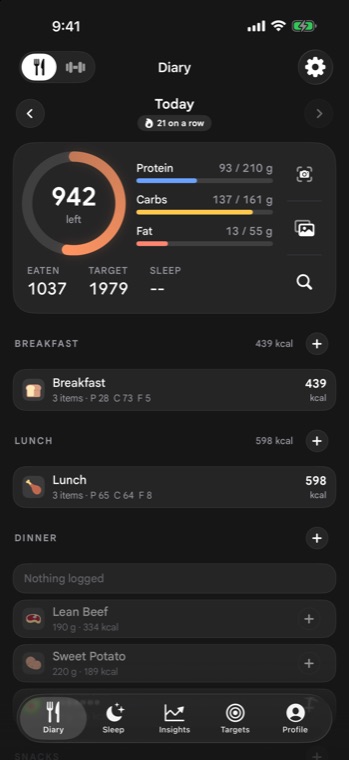
Nutritional strategy is the biological substrate upon which all training adaptations occur. You can execute pristine progressive overload in the gym with an advanced workout tracker, but if your daily caloric balance and macronutrient distribution fail to match your physiological objectives, muscle hypertrophy stalls and body fat accumulation persists. Yet for millions of fitness enthusiasts, nutrition tracking is synonymous with obsessive manual math, cumbersome food databases riddled with inaccurate entries, and tracking burnout that leads to abandoned diets. Modern nutritional tracking has evolved beyond tedious manual logging into an agile, data-driven science. By understanding energy balance physiology and leveraging rapid scanning technology, anyone can master flexible dieting with zero cognitive friction.
In this definitive guide, we break down the thermodynamics of body recomposition, calculate optimal macronutrient ratios for fat loss versus muscle gain, analyze the accuracy differences between barcode scanning, AI plate photography, and nutrition label OCR, and provide an actionable daily protocol using an intelligent food tracker.
1. The Thermodynamics of Energy Balance: First Law Physiology
All human nutritional metabolism operates under the First Law of Thermodynamics: energy within a closed biological system cannot be created or destroyed, only transformed. When the chemical energy consumed from food (Calories In) exceeds the energy expended through basal metabolic rate, the thermic effect of food, non-exercise activity thermogenesis (NEAT), and exercise activity (Calories Out), the net caloric surplus is stored as adipose tissue or incorporated into new skeletal muscle fibers.
Conversely, when energy expenditure exceeds energy intake, a negative energy balance (caloric deficit) ensues. The body must oxidize endogenous fuel reserves (predominantly triglycerides stored in adipose tissue, alongside glycogen and minor amino acid catabolism) to satisfy metabolic demands. No metabolic diet, fasting window, or hormone optimization protocol can bypass this physical law.
However, while total calories determine the direction and rate of body weight change, macronutrient composition dictates the composition of that weight change. Consuming 2,000 calories composed primarily of refined sugars will produce vastly different muscular retention, hormonal balance, and body composition outcomes compared to 2,000 calories balanced with adequate high-quality protein, complex carbohydrates, and essential fatty acids.
2. The Macronutrient Triad: Roles, Ratios, and Hypertrophy
Each of the three primary macronutrients serves distinct biochemical roles within human physiology. Optimizing these ratios is the key to preserving lean tissue during fat loss phases and maximizing myofibrillar protein synthesis during muscle building phases.
Protein: The Contractile Architecture
Proteins are comprised of twenty amino acids, nine of which are essential and cannot be synthesized endogenously. Skeletal muscle tissue is in a continuous state of turnover, alternating between muscle protein synthesis (MPS) and muscle protein breakdown (MPB). For muscle hypertrophy to occur, total daily MPS must exceed total daily MPB over time.
Dozens of meta-analyses (notably by Dr. Robert Morton and colleagues) indicate that a daily protein intake between 1.6 grams and 2.2 grams per kilogram of total body weight (0.73 to 1.0 grams per pound) maximizes MPS in resistance-trained individuals. During an aggressive caloric deficit where lean tissue is vulnerable to catabolism, increasing protein intake up to 2.4 to 2.7 g/kg provides enhanced satiety and safeguards lean mass.
Furthermore, each meal should aim to trigger the “leucine trigger”: approximately 2.5 to 3.5 grams of the essential amino acid leucine (found in roughly 25 to 40 grams of complete protein like chicken, eggs, beef, fish, or whey), which directly activates the mTORC1 signaling complex.
Carbohydrates: The High-Intensity Glycogen Fuel
While carbohydrates are technically non-essential for basic human survival, they are biologically non-negotiable for high-performance resistance training. Anaerobic glycolysis is the primary metabolic pathway utilized during intense resistance training sets lasting 15 to 45 seconds. Muscle glycogen serves as the immediate substrate for ATP resynthesis during heavy squats, presses, and deadlifts.
Depleted glycogen stores impair intracellular calcium release from the sarcoplasmic reticulum, resulting in premature muscle fatigue, lower bar velocity, and diminished volume load in your workout tracker. Trainees should allocate between 3.0 to 6.0 grams of carbohydrates per kilogram of body weight during muscle building phases, and 2.0 to 3.5 g/kg during cutting phases, prioritizing complex starches, oats, rice, potatoes, and fresh fruits around the training window.
Dietary Fats: Endocrine and Cellular Health
Fats are critical for cellular membrane fluidity, the absorption of fat-soluble vitamins (A, D, E, K), and the endogenous synthesis of steroid hormones, including testosterone. Dropping dietary fat below 15% to 20% of total daily caloric intake can cause systemic endocrine suppression, libido reduction, and dry joints.
As a baseline rule, ensure daily fat intake does not drop below 0.6 to 1.0 grams per kilogram of body weight (or approximately 20% to 30% of total daily calories), emphasizing monounsaturated and polyunsaturated fats from olive oil, avocados, whole eggs, nuts, and omega-3 fatty acids from wild fish.
3. Macronutrient Targets: Bulking vs. Cutting vs. Recomposition
The following table provides evidence-based daily macronutrient guidelines calibrated for a standard 80 kg (176 lb) lifter across different training objectives:
| Training Phase | Caloric Target (% TDEE) | Protein (g / kg) | Carbohydrates (g / kg) | Fats (g / kg) | Primary Adaptation Focus |
|---|---|---|---|---|---|
| Lean Muscle Gain (Lean Bulk) | +10% to +15% Surplus (~2,800 kcal) | 1.8 to 2.2 g/kg (145-175g) | 4.5 to 6.0 g/kg (360-480g) | 0.8 to 1.0 g/kg (65-80g) | Maximal MPS with minimal adipose tissue accumulation |
| Fat Loss (Moderate Cut) | -20% to -25% Deficit (~2,000 kcal) | 2.2 to 2.6 g/kg (175-210g) | 2.0 to 3.0 g/kg (160-240g) | 0.6 to 0.8 g/kg (50-65g) | Preserving lean muscle mass while oxidizing body fat |
| Body Recomposition (Maintenance) | 0% Maintenance (~2,500 kcal) | 2.0 to 2.4 g/kg (160-190g) | 3.0 to 4.0 g/kg (240-320g) | 0.7 to 0.9 g/kg (55-72g) | Simultaneous fat reduction and muscle gain in intermediates |
| Aggressive Mini-Cut (Short Term) | -30% to -35% Deficit (~1,700 kcal) | 2.5 to 2.8 g/kg (200-225g) | 1.5 to 2.0 g/kg (120-160g) | 0.5 to 0.6 g/kg (40-50g) | Rapid 2-to-4 week fat reduction between muscle building cycles |
4. The Evolution of Food Logging: From Manual Math to AI Vision
The primary barrier to successful long term nutrition tracking is friction. In legacy fitness apps, logging a home-cooked meal required typing out “chicken breast”, scrolling through 50 user-generated database entries with conflicting calorie counts, typing “olive oil”, typing “white rice”, and manually estimating gram weights. Doing this three to four times per day creates psychological fatigue that leads to 80% of trainees abandoning food tracking within six weeks.
Modern nutrition tracking in IMPOLS removes this friction through high-speed computer vision and hardware integration:
Barcode Scanning with Curated Databases
For packaged supermarket foods, a high-speed camera barcode scanner provides instant 100% verified nutrition data. Rather than relying on crowd-sourced community logs that often contain zero protein or incorrect sodium values, verified databases ensure your logged numbers reflect official nutritional facts labels.
Nutrition Label OCR (Optical Character Recognition)
Many specialized, imported, or artisanal foods lack registered barcodes in international databases. Modern label scanners utilize on-device neural networks to read the printed nutrition facts panel directly off the package (in English and Hebrew). In a single camera pass, the algorithm extracts calories, protein, carbohydrates, fats, sodium, and dietary fiber, populating your food log in under two seconds.
AI Plate Photography and Portion Estimation
When dining at restaurants or eating home-cooked composite meals where barcodes do not exist, AI food photo scanning estimates ingredients and volume. By snapping a photo of your plate, machine vision models identify distinct items (such as grilled salmon, roasted sweet potatoes, and steamed broccoli) and suggest reasonable portion estimates that you can fine-tune with a quick slider tap.
5. Step-by-Step Protocol: The Sustainable Daily Macro Logging System
To integrate macro tracking into your daily life without letting it dominate your mental energy, implement this sustainable 4-phase system:
Phase 1: Calculating Baseline TDEE and Setting Targets
Weigh yourself daily for seven consecutive mornings upon waking and after using the restroom. Log your current food intake naturally for one week without dieting. Calculate your average daily weight and calories. If your weight is stable, you have found your true Total Daily Energy Expenditure (TDEE). Adjust calories by +300 for muscle building or -500 for fat loss, and establish your macro targets in your food tracker.
Phase 2: Pre-Logging and Meal Templates
The most effective strategy for hitting macro targets is “pre-logging.” Instead of wondering what you can eat at 9:00 PM when you have 12 grams of protein and 4 grams of fat remaining, log your planned breakfast, lunch, and dinner the night before or first thing in the morning. Build custom Meal Templates in your app for meals you consume regularly (such as your morning protein oatmeal or post-workout rice bowl) to enable one-tap logging.
Phase 3: The 80/20 Whole Food Principle
While flexible dieting (IIFYM – If It Fits Your Macros) allows for dietary variety, your metabolic health and satiety require nutrient density. Ensure that at least 80% of your daily calories originate from minimally processed whole foods: lean meats, seafood, eggs, legumes, potatoes, oats, fibrous vegetables, berries, and healthy fats. Reserve the remaining 10% to 20% for discretionary treats to maintain psychological adherence and prevent binge-eating cycles.
Phase 4: Monitoring Trends and Autoregulating Intake
Track your 7-day rolling weight average alongside your volume load in your workout tracker. If your goal is fat loss and your 7-day average has not decreased across two consecutive weeks, decrease daily carbohydrates by 25 to 30 grams. If your goal is muscle gain and you are gaining faster than 0.5% of body weight per week, trim calories slightly to ensure gains consist of contractile muscle rather than excess body fat.
6. Common Macro Tracking Pitfalls and How to Overcome Them
Pitfall 1: Forgetting Cooking Oils, Dressings, and Condiments
A single tablespoon of olive oil or butter contains approximately 120 calories and 14 grams of pure dietary fat. Trainees often carefully weigh 200 grams of chicken breast but fail to log the two tablespoons of oil drizzled into the skillet, inadvertently erasing a 250-calorie deficit. Always account for liquid fats and sauces.
Pitfall 2: Weighing Meat Cooked vs. Raw Inconsistently
Meat loses 20% to 25% of its physical weight during cooking due to water evaporation. Consequently, 100 grams of raw chicken breast contains approximately 23 grams of protein and 110 calories, while 100 grams of cooked chicken breast contains approximately 31 grams of protein and 150 calories. Always standardize your food log entries to match the state in which you weighed the food (preferably raw, or select “cooked” entries specifically).
Pitfall 3: Obsessing Over Micron-Level Perfection
Your body does not operate as an isolated ledger that balances at midnight. If your target is 180 grams of protein and you hit 175 grams, or your carbohydrate target is 250 grams and you hit 260 grams, the physiological difference is completely negligible. Aim to hit your macro targets within a +/- 5% buffer rather than inducing psychological stress over single grams.
7. Connecting Nutrition to Sleep and Muscular Recovery
Nutrition and recovery operate as an interconnected biological circuit. Sub-optimal caloric intake disrupts sleep architecture by elevating nocturnal cortisol and waking you with hunger pangs. Conversely, chronic sleep deprivation depresses leptin (the satiety hormone) and elevates ghrelin (the hunger hormone), driving intense cravings for hyper-palatable refined sugars and carbohydrates.
By pairing your nutrition log with an intelligent sleep and recovery tracker, you can monitor how late-night meal timing and macronutrient distribution affect your resting heart rate and deep sleep stages, creating a closed-loop system for peak physical performance.
8. Frequently Asked Questions
Do I need to track every single vegetable and seasoning?
Fibrous non-starchy vegetables (such as spinach, cucumbers, celery, and lettuce) contain minimal caloric density and high thermic cost. Unless you are in the final weeks of contest prep for a bodybuilding show, obsessing over logging lettuce leaves is unnecessary. Focus your tracking accuracy on energy-dense foods: proteins, starches, fruits, nuts, and fats.
What is the difference between net carbs and total carbs?
Total carbohydrates include dietary fiber and sugar alcohols, while net carbohydrates subtract dietary fiber (since insoluble fiber is largely non-digestible). For standard athletic performance and macro logging, tracking total carbohydrates and ensuring at least 30 to 40 grams of daily fiber is the gold standard for gut health and insulin sensitivity.
Can I build muscle without tracking macros?
Yes, particularly for beginners who improve their protein intake intuitively. However, as you advance toward your genetic ceiling, the margin for error narrows dramatically. Tracking macros provides the quantitative guarantee that your body has the exact amino acid and glycogen resources required to synthesize new tissue.
How does barcode scanning handle international or imported products?
Advanced platforms like IMPOLS support global barcode formats (UPC, EAN) alongside on-device OCR that reads nutritional facts panels in multiple languages (including English and Hebrew), ensuring zero food logging blind spots regardless of where you shop.
9. Summary and Nutrition Implementation Checklist
Nutritional tracking is the ultimate lever of physical transformation. By calculating precise targets, utilizing modern scanning tools, and focusing on long term weekly averages rather than daily perfection, you master body recomposition with total confidence.
- Establish your maintenance TDEE and set realistic caloric surpluses (+10%) or deficits (-20%).
- Prioritize daily protein intake at 1.8 to 2.2 g/kg, distributed across 3 to 5 meals containing at least 3g of leucine.
- Use an integrated food tracker with barcode scanning and label OCR to log meals in seconds.
- Pre-log meals and save frequent combinations as templates to eliminate daily decision fatigue.
- Sync nutritional intake with your progressive gym performance on your workout tracker and monitor sleep readiness with a sleep tracker.