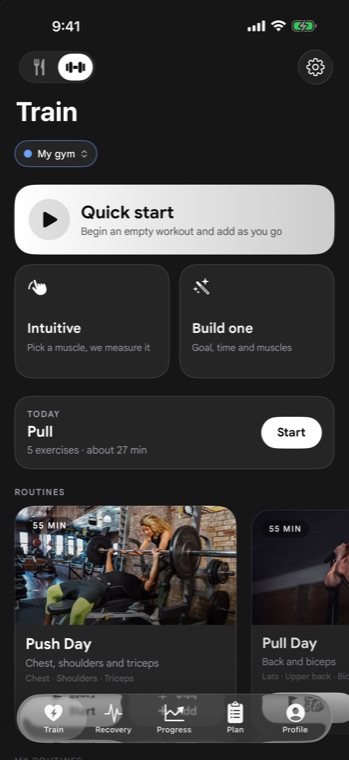
Progressive overload is the fundamental physiological principle governing muscle hypertrophy, strength development, and neuromuscular adaptation. Without a structured, measurable increase in the demands placed upon skeletal muscle over time, your body has zero physiological incentive to synthesize new contractile tissue or increase motor unit recruitment. Yet millions of lifters walk into the gym week after week relying purely on memory, vague feelings, or unstructured notes that fail to capture the quantitative variables that dictate muscular growth. In this comprehensive guide, we dissect the exact biomechanics and mathematical formulas behind progressive overload, demonstrate why pen-and-paper logs break down under fatigue, and outline a step-by-step digital logging framework using modern tools like a dedicated workout tracker and companion smartwatch sensors.
1. The Physiological Foundations of Mechanical Tension and Adaptation
At its biological root, resistance training induces muscular adaptation through Hans Selye’s General Adaptation Syndrome (GAS). When skeletal muscle fibers contract against high external resistance, they experience mechanical tension. This mechanical tension is transduced via costameric integrins and focal adhesion complexes into intracellular biochemical signaling pathways, primarily activating the mammalian target of rapamycin complex 1 (mTORC1). This molecular cascade upregulates muscle protein synthesis (MPS) above muscle protein breakdown (MPB), leading to the accumulation of actin and myosin filaments within myofibrils.
However, human physiology is extraordinarily efficient at conserving energy. Once your neuromuscular system adapts to a specific magnitude of mechanical tension, that exact stimulus ceases to trigger hypertrophic signaling. It shifts from an adaptive stimulus into a mere maintenance stimulus. To re-ignite the signaling cascade, you must apply progressive overload: systematically increasing the external stimulus beyond your current habituation threshold.
Historically, trainees have conflated progressive overload with simply adding iron plates to a barbell. While increasing external load is a primary driver, progressive overload actually encompasses several distinct mechanical and metabolic variables that can be adjusted systematically across mesocycles:
- Absolute External Load: Increasing the physical mass lifted while keeping tempo, range of motion, and technical execution strictly identical.
- Repetition Density: Performing more repetitions with a fixed load within a standardized time under tension framework.
- Volume Load (Tonnage): Increasing the mathematical product of sets, repetitions, and weight across a weekly microcycle without exceeding systemic recovery capacity.
- Proximity to Failure: Reducing your Reps in Reserve (RIR) from a conservative 3 RIR down to an intense 1 or 0 RIR on key working sets.
- Eccentric Control and Active Range of Motion: Standardizing full active range of motion and controlled eccentric tempos to maximize passive mechanical tension.
- Rest Interval Economy: Completing equivalent volume load with optimized rest intervals, improving metabolic clearance and neuromuscular work capacity.
The Golden Rule of Progressive Tension
Volume load is only as valuable as the mechanical quality of each repetition. If you add 5 kg to a barbell bench press but cut your range of motion two inches above your chest, you have not achieved progressive overload; you have merely shifted tension away from the pectoralis major and onto connective tissue.
2. Why Memory and Paper Notebooks Fail in Modern Strength Training
Many trainees believe they possess the mental acuity to remember what they lifted in their previous session. Cognitive psychology and empirical exercise science refute this belief entirely. During strenuous resistance training, elevated lactate, catecholamine release, and cerebral oxygenation shifts impair acute working memory. Trainees consistently misremember whether they achieved 8 or 9 reps on their third set of dumbbell shoulder presses, or whether their rest period was 90 seconds or three minutes.
Physical paper notebooks offer an obvious improvement over pure memory, yet they introduce significant friction in a live gym environment. A physical notebook does not calculate historical tonnage, does not display percentage progression over time, and cannot trigger haptic rest timers between sets. Flipping through smudged pages while sweating under gym lights distracts your mental focus during critical warm-up and working sets.
By utilizing a modern workout tracker on your phone and wrist, every prior performance is surfaced instantaneously. When you approach the barbell, your target numbers for today are displayed directly in front of you: the exact load, target reps, and historical RIR. This clarity transforms training from subjective guesswork into an objective engineering process.
3. Volume Load vs. Hard Sets: Defining Effective Stimulus
In classic strength literature, volume was defined purely as Volume Load = Sets × Reps × Weight. While volume load provides a broad gauge of mechanical work, contemporary hypertrophy research (spearheaded by researchers such as Dr. Brad Schoenfeld and Dr. James Krieger) reveals that not all repetitions contribute equally to muscle growth.
When you perform a set of 12 repetitions with a light weight, the first 6 or 7 repetitions recruit predominantly low-threshold motor units that possess limited growth potential. Only as muscle fibers fatigue and the nervous system recruits high-threshold motor units (Henneman’s size principle) do the remaining repetitions generate maximal mechanical tension across fast-twitch fibers.
Consequently, contemporary exercise science defines an “Effective Set” (or Hard Set) as any working set taken within 0 to 3 reps of concentric muscular failure (0-3 RIR). If a set is completed at 6 RIR, it contributes to systemic fatigue without providing sufficient tension to stimulate myofibrillar protein synthesis.
4. Biomechanical Standardization: The Pre-Requisite of Measurement
To establish meaningful tracking metrics, every repetition must adhere to rigorous biomechanical standards. If the physical distance traveled by the barbell or dumbbell varies between sessions, your calculations of mechanical work are fundamentally flawed. Mechanical work in physics equals Force multiplied by Displacement. If you decrease displacement by 10% by cutting squat depth, you perform 10% less physical work even if the weight on the bar remains identical.
To ensure standardization across months of training, document and adhere to three non-negotiable execution parameters:
First, standardized joint angles at terminal range. For squats, this means the hip crease breaking below the top of the patella. For bench pressing, this requires the barbell lightly touching the lower sternum without bouncing. For pull-ups, this demands a dead hang at the bottom with chin fully clearing the horizontal bar at the top.
Second, standardized cadence. A two to three second controlled eccentric descent followed by an explosive concentric drive recruits the maximum number of motor units while minimizing momentum. If you drop the weight freely during the negative phase, you eliminate the high-tension eccentric component that stimulates longitudinal sarcomerogenesis.
Third, standardized rest periods. Resting 60 seconds on Tuesday and 4 minutes on the following Monday alters intracellular phosphocreatine resynthesis and metabolic clearance. Consistent rest periods, tracked via a wrist-based countdown timer, ensure that changes in rep performance reflect true physiological adaptation rather than variable recovery between sets.
5. Progressive Overload Metrics Comparison Matrix
The following matrix compares the core quantitative metrics utilized in evidence-based strength tracking, outlining their practical application and limitations:
| Tracking Metric | Calculation Formula | Primary Benefit | Common Limitation | Recommended Use Case |
|---|---|---|---|---|
| Absolute External Load | Current Mass (kg/lbs) | Directly measures maximum force output and neural drive | Plateaus quickly in intermediate and advanced lifters | Compound barbell lifts (Squat, Bench, Deadlift) |
| Total Volume Load | Sets × Reps × Load | Quantifies macro mechanical work and work capacity | Can be padded with non-stimulating junk volume | Monitoring microcycle workload trends across months |
| Effective Hard Sets | Count of sets at 0-3 RIR | Directly correlates with hypertrophic stimulus landmarks | Does not reflect progression in load or movement velocity | Hypertrophy-focused bodybuilding splits (PPL, Upper/Lower) |
| Reps in Reserve (RIR) | Estimated reps before failure | Autoregulates daily training according to biological readiness | Subjective; novices frequently underestimate true capacity | Guiding daily set termination and fatigue management |
| Concentric Velocity | Meters per second (m/s) | Provides 100% objective measurement of neuromuscular fatigue | Requires high-precision wearable accelerometer sensors | Velocity based training and power development on smartwatch |
6. The Step-by-Step Double Progression Protocol
Phase 1: Establishing Repetition Brackets and Baselines
Begin by assigning each exercise in your program an explicit repetition bracket based on stability and joint dynamics. Compound barbell lifts thrive in a 6 to 8 repetition bracket, multi-joint machine and dumbbell movements perform optimally in an 8 to 12 bracket, and single-joint isolation exercises excel in a 12 to 15 repetition bracket.
In your first session, select a conservative load where you can achieve the bottom of the repetition bracket on all planned working sets with pristine technical form and at least 2 RIR.
- Choose your target rep bracket (e.g., 3 sets of 8 to 12 reps on Incline Dumbbell Press).
- Select a starting weight where set 1 feels like 2 RIR (e.g., 30 kg dumbbells).
- Log your completed sets into your workout tracker immediately upon finishing each set.
Phase 2: Advancing Repetitions Across Working Sets
In subsequent training sessions, your sole objective is to add repetitions across your working sets while keeping the external load completely static. Do not increase the weight until you have filled the entire repetition bracket across every designated set.
For instance, if Session 1 yielded 10, 9, and 8 reps with 30 kg, your objective for Session 2 is to achieve at least 10, 10, 9 or 11, 9, 8. Every additional clean repetition represents an increase in total volume load and time under high mechanical tension.
Phase 3: Earning the Load Increment
Once you achieve the maximum repetition threshold on all sets (e.g., 12, 12, and 12 repetitions at 30 kg), you have earned the right to advance the external load in your subsequent workout.
Increase the load by the smallest available increment (typically 2 kg to 2.5 kg total). Because the load is heavier, your repetitions will naturally regress toward the bottom of the bracket (e.g., 9, 8, 8 reps at 32.5 kg). You now restart the cycle, building your reps back up to 12.
Phase 4: Mesocycle Review and Deload Integration
Track your double progression over a 4 to 8 week training block. When progression slows and acute neuromuscular fatigue blunts performance across two consecutive workouts, integrate a planned deload week to dissipate systemic fatigue before commencing your next accumulation block.
7. Common Tracking Pitfalls That Invalidate Progressive Overload
Sacrificing Range of Motion to Claim Fake Progress
The single most common pitfall in gym tracking is shortening the range of motion to force an increase in weight or reps. Shifting from a below-parallel squat to a half-squat reduces active muscle fiber recruitment and tendon strain while artificially elevating logged numbers. Always maintain consistent biomechanical execution before logging progression.
Accumulating Junk Volume Instead of Tension
Adding endless sets of low-intensity exercises creates high metabolic fatigue and joint wear without providing sufficient mechanical tension. Research demonstrates that 10 to 20 hard working sets per muscle group per week represents the optimal ceiling for most drug-free trainees.
Ignoring Nutritional and Recovery Inputs
Progressive overload cannot materialize without adequate substrate support and cellular recovery. If daily protein intake is deficient or sleep is truncated, your nervous system will fail to generate maximal force output. Pair your lifting log with an accurate macro tracker and monitor biological readiness with a recovery and sleep tracker.
Frequently Asked Questions
How frequently should an intermediate lifter add weight to the bar?
Intermediate lifters should not expect linear session-to-session load increases. In a double progression model, adding 1 to 2 total repetitions across working sets each week is outstanding progress. Load increases typically occur every 3 to 5 weeks on compound movements.
What should I do if my reps stall on an exercise for three consecutive workouts?
First, check your sleep duration and caloric intake to rule out systemic under-recovery. Second, verify whether your rest intervals are consistent. If recovery is adequate, implement a 1-week deload, or substitute the stalled movement with an equivalent exercise variation to challenge motor unit recruitment from a slightly different angle.
Does progressive overload work while in a caloric deficit?
Yes, but the goal during a caloric deficit shifts from aggressive volume expansion to maintaining absolute strength and heavy loads. Preserving your top working loads signals to your physiology that muscle tissue is metabolically necessary, preventing lean tissue loss during fat reduction.
Can wearable devices track progressive overload automatically?
Yes. Advanced platforms like IMPOLS on Apple Watch and Wear OS utilize tri-axial accelerometers and gyroscopes to track rep velocity, set completion, and rest intervals directly on your wrist, eliminating the distraction of logging on a phone screen.
8. Summary and Systematic Tracking Checklist
Progressive overload is an objective biological discipline, not an emotional pursuit. By establishing concrete baseline numbers, utilizing double progression, and tracking every variable with precision, you guarantee long term muscular and strength development.
- Define clear rep brackets (6-8, 8-12, or 12-15) for every exercise in your routine.
- Log every completed set with load, reps, and RIR into your workout tracker.
- Only increase weight after achieving the maximum rep ceiling across all planned sets.
- Maintain standardized technical execution, controlled eccentric tempo, and full range of motion.
- Support muscular adaptation with optimized nutrition logged via a food tracker and restorative sleep monitored through sleep tracking.